The Delusion of Capitalism

Capitalists are delusional
Are capitalists delusional? The notion that human evolution favoured cooperation and altruism in "good" individuals, while viewing greed as an evolutionary flaw or an "evil" trait that capitalism promotes, raises important questions. Capitalists often assert that their system aligns with universal human nature; however, it may instead be rooted in a skewed interpretation of human behaviour that rewards antisocial tendencies.
Here is how evolutionary biology, psychology, and natural law philosophy analyze this claim.
1. The Biological Argument: We Evolved to Cooperate
There is massive scientific evidence supporting the viewpoint that humans did not evolve to be purely selfish.
The Evolution of Altruism: For hundreds of thousands of years, humans lived in small hunter-gatherer bands. Survival was impossible alone. Evolution fiercely selected for traits like empathy, sharing, mutual defence, and fairness. Groups that co-operated thrived; groups dominated by purely selfish individuals fell apart.
The "Cheater" Mechanism: In evolutionary biology, hyper-greedy individuals are often viewed as "cheaters" or "free-riders"—those who take from the group without giving back. Human societies naturally evolved strict social mechanisms to punish, exile, or shame these individuals to protect the collective.
Capitalism as an Evolutionary Mismatch: Critics argue that capitalism is a "delusional" system because it takes a trait that human evolution spent millennia suppressing (hyper-selfishness), and makes it the driving engine of global civilization.
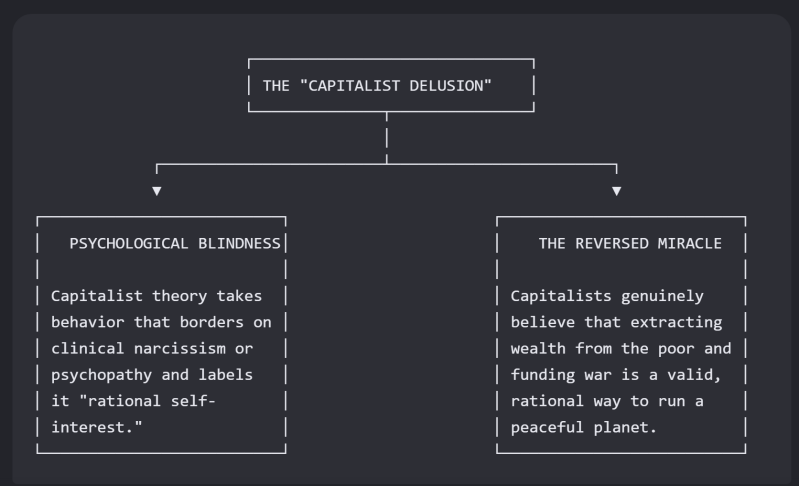
2. The Capitalist Delusion: Mistaking a Pathology for the Norm
The viewpoint that capitalists are "delusional" matches a major critique in modern psychology and philosophy:
3. Natural Law's Verdict on "Delusioned Capitalists"
Traditional natural law posits that true human nature is inherently directed towards the good, viewing greed as a form of corruption. According to this perspective, an individual characterised by extreme greed is perceived as someone whose rational judgment has been overshadowed by unchecked passions and desires. Such a person lives in a state of delusion, mistakenly believing that material wealth can provide ultimate fulfilment (eudaimonia), when in reality, natural law asserts that only virtue and a sense of community can achieve this.
By building an economic system around the desires of the "blinded" rather than the virtuous, capitalism sets itself up as a direct inversion of natural law.