A World Without Money
We have architected a Meritocratic Technocracy that balances humanitarian safety nets with high-performance incentives. In this society, money is obsolete, replaced by a Global Resource Ledger and a Tenure-Based Medal/Card System.
Summary: How it all works
A Human-Centric Technocratic Socialist Model is a governance framework that replaces traditional money and profit motives with a resource-based economy driven by thermodynamics and scientific efficiency. Society is organized into eight global Technates, each overseen by a Global Resource Board that manages a strict carbon ceiling and real-time inventory through a digital ledger. Citizens are guaranteed basic necessities, but they can earn temporary luxury status through a point system tied to labor demand and social reliability scores. Automated infrastructure and specialized government departments handle industrial production and social services, prioritizing access over private ownership to minimize ecological impact. To prevent tyranny, the system incorporates citizen juries and digital veto powers, allowing the public to override technocratic plans. Ultimately, the model seeks to balance high-performance civilization with planetary survival by substituting financial competition for meritocratic social contribution.
1. The Currency: Points and Medals/Cards
Instead of cash, social status and luxury access are determined by Points earned through labour. Points are stored in Cards, which can be redeemed to unlock different tiers of living.
- Bronze (0 pts): The baseline. Access to Functional Housing and all basic needs (food, healthcare, education).
- Silver (200 pts): Intermediate perks and increased transit/good options.
- Gold (400 pts): Access to Luxury Housing, artisanal goods, flying, and high-sovereignty perks.
Citizens have a spendable Wallet that resets to 0 whenever they redeem a Silver or Gold Card.
Labour Tiers (Point Generation)
The speed at which you earn luxury depends on the labour track, tracking supply and demand. If a job is in critical demand, you get the most points.
- Critical Demand Jobs: 200 pts/yr (Gold Card every 2 years).
- Equilibrium Jobs: 100 pts/yr (Gold Card every 4 years).
- Saturated/surplus Jobs: 50 pts/yr (Gold Card every 8 years).

2. Priority for Luxury Items
To be prioritised for luxury items, citizens must have a high social credit score. This score is divided into two parameters: Contribution Value (CV) and Social Reliability (SR). This effectively balances individual capability with civic responsibility.
Here is how the ledger calculates, displays, and enforces this two-pillar formula across the technates:
The Unified Social Credit Formula
To determine a citizen’s final Priority Rank for waitlists, the ledger weighs these two distinct pillars alongside their active card status:
Social Credit Score (SCS) = Contribution Value (CV) + Social Reliability (SR)
While CV tracks a citizen's industrial and intellectual output, SR tracks their character, empathy, and community standing.
How are Contribution Value (CV) scores assigned?
The CV metric prevents the system from becoming purely mechanical. It explicitly rewards complexity, problem-solving, and generational mentorship.
- The Baseline Economy (1–10 pts): Covers foundational, essential tasks. A citizen cleaning a public transport hub or sorting raw recycling inputs receives steady, predictable CV points.
- The Specialised Track (20–50 pts): Unlocked through proven technical expertise. Performing a complex neurological procedure or recalibrating a technate's automated power grid mints a high-density spike of CV.
- The Knowledge Multiplication Engine (100+ pts): This is a brilliant structural masterstroke. When an expert takes on an apprentice or teaches a specialised skill, they don't just receive a flat 100-point reward. They are granted a residual percentage of that student's future minted points for life.
How are Social Reliability (SR) scores assigned?
If CV measures a citizen's capability, SR measures their kindness, reliability, and respect for the collective ecology. Starting every citizen at a neutral 100 points allows the ledger to monitor behavioural drift.
- Stewardship (+10 to +30): Rewarding the maintenance of public spaces or volunteering for unclaimed, dirty, or low-prestige tasks ensures that the physical environment remains immaculate without forcing anyone into conscripted labour.
- Peer Validation (+5): Fellow members of your Local Organisation (LO) can instantly validate your teamwork, patience, or leadership. This turns everyday peer respect into an active asset.
- Minor Violation (-20): Carelessness is immediately checked. Forgetting to clear a luxury villa's automated kitchen before a grace period deadline, wasting scarce agricultural luxury yields, or failing to show up for a committed infrastructure shift drops your score instantly.
- Systemic Violation (-100+): Intentional sabotage, anti-social malice, or causing physical harm to another human being triggers an absolute collapse of the SR meter.
Why Points and SR Scores are Kept Separate
It is vital to remember that the SR score is entirely distinct from points earned through labour. Points get you luxury status cards; your SR score gives you priority for luxury items.
3. The Luxury Lifecycle
Luxury is temporary to ensure the Resource Ledger remains fluid and resources are not hoarded by those not contributing.
- The 2-Year Expiry: A Gold Card grants luxury access for 2 years. To maintain that lifestyle, you must continuously earn another 400 points.
- The 3-Month Grace Period: When a card expires, you have 90 days to produce a new one. If you fail, your belongings are moved to storage, and you must vacate your luxury home for your Functional Apartment.
- Decoupled Needs: You never lose your Functional Apartment; luxury is an "extra" layer, not a requirement for survival.
4. The Path to "Permanent Gold" (Retirement)
Citizens can "win the game" by earning a cumulative total of 6000 points, after which they receive the perks forever.
The Universal Backstop: At age 65, every citizen is automatically granted a Permanent Gold Card regardless of their point total.

5. The Decay Rate
To achieve absolute balance between physical reality and human psychology, the best design outcome is a hybrid split-ledger system.
If points never expire, they behave exactly like legacy fiat currency—allowing individuals to hoard purchasing power across generations, recreate artificial class divides, and cause catastrophic imbalances between outstanding points and actual physical resources.
Therefore, the optimal architectural design splits the survival of points across the dual-metric ledger: The Lifetime Contribution Ledger is eternal, but the Spendable Wallet is subject to Thermodynamic Decay (Demurrage).
Once a spendable point crosses its 24-month expiration threshold without being locked into a Silver or Gold Card, it enters a rapid linear decay curve, losing exactly 33.3% of its original value every 30 days. By day 90 post-expiration, that specific point hits zero.

6. Social Safety Nets
Society ensures that the most vulnerable are treated as the most honored.
- Disability Status: Those with profound cognitive or physical disabilities who cannot participate in the design or labour force at all receive a Permanent Gold Card from day one, giving them stable access to the best housing and resources without the need for points.
- Universal Basic Dignity: Because basic needs are decoupled from the point system, no one ever experiences poverty, even during their "Bronze" years.
7. System Infrastructure
To manage this without human corruption or market fluctuations, the society relies on:
- The Global Ledger: A real-time database of every resource on Earth.
- The Sensor Grid: IoT and AI monitoring supply and demand to ensure "Gold-tier" luxuries are available for those who earn them.
- Automated Logistics: Robotic systems that handle the movement and storage of belongings during the 1-month transition periods.
Final Summary of the Social Vibe
This is a "Sprint and Rest" society. It rewards high-intensity expertise with constant luxury, while offering a slower, steadier path for others. It eliminates the fear of poverty but replaces it with the ambition for status, creating a world that is highly productive, technologically advanced, and fundamentally humane.
The audio presentation below explores a meritocratic Resource-Based Economy in more detail. Enjoy!
Citizens Veto
In a pure technocracy, the government makes the primary allocation decisions while giving citizens a direct veto power. This model reverses the workflow of direct democracy: instead of citizens proposing and voting on every plan, the state’s technocrats and algorithms draft the resource plan, and citizens act as a systemic "brake" or "override" switch.
1. The Digital Citizen Veto (The "Kill Switch")
In a moneyless system, the government publishes draft resource allocation plans (e.g., how much steel goes to rail transit versus medical equipment) to a transparent digital ledger.
- The Threshold Veto: Citizens have a set window (e.g., 14 days) to review the plan. If a specific percentage of the population (such as 5% or 10%) digitally signs a petition against it, the plan is frozen.
- The Binding Referendum: Once the threshold is crossed, an automated, mandatory vote is triggered for the entire affected population to permanently pass or kill the proposal.
- The "Null" Default: If a plan is successfully vetoed, the system automatically reverts to the previous year's allocation baseline or a pre-programmed emergency survival budget until a new plan is drafted.
2. Multi-Tiered Veto Scopes
To prevent decision paralysis, veto power is scaled according to the geographic and social impact of the decision.
- Hyper-Local Vetoes: Only the immediate neighborhood can veto the construction or closure of a local distribution hub or community kitchen.
- Regional/Bioregional Vetoes: Watershed management, regional rail lines, or local agricultural shifts are subject to vetoes by residents of that specific ecological zone.
- Global/National Vetoes: Macro-decisions, like shifting massive amounts of lithium from consumer electronics to grid-scale medical backups, require a population-wide veto mechanism.
3. Deliberative Citizen Juries
To avoid "veto fatigue"—where citizens are overwhelmed by thousands of technical government proposals—a system of sortition (random selection) can be used.
- Representative Panels: A randomly selected, demographically representative panel of citizens is picked by an algorithm (similar to jury duty).
- Expert Briefings: This citizen jury is given paid time to study the government's resource proposals, consult with independent scientists, and look at the physical inventory data.
- The Gatekeeper Veto: If this specific jury votes against the government's plan, it is blocked and sent back to the drawing board, saving the general public from constant voting.
4. Algorithmic Guardrails and Alarm Triggers
Citizens can also wield an automated algorithmic veto based on pre-defined ecological or human-need boundaries.
- Metric Triggers: Citizens can vote to set strict legal boundaries on data—for example, "Local water tables cannot drop below X level."
- Automatic Injunction: If a government production plan mathematically violates that citizen-mandated boundary, the tracking software automatically triggers a veto and halts the supply chain, requiring human intervention to rewrite the plan.
Deliberative Citizens Jury (explained)...
Deliberative citizen juries do not happen on every single government proposal. Doing so would cause systemic paralysis, as governments make thousands of micro-decisions daily, from routing delivery trucks to updating software code.
Instead, a moneyless, veto-based society uses specific filters to determine exactly when a citizen jury is triggered.
1. The Trigger Mechanisms
A proposal is only sent to a citizen jury if it meets specific, high-impact criteria:
- Constitutional or Structural Shifts: Major changes to how the resource tracking system itself operates, or changing the baseline "survival budget" guaranteed to all citizens.
- Large-Scale Resource Reallocation: Shifting significant percentages of global or regional materials from one sector to another, such as diverting plastic production from consumer goods to medical supplies.
- High-Impact Projects: Megaprojects that permanently alter the physical landscape, such as building a new high-speed rail line, a massive dam, or a regional automated recycling center.
- Citizen Petition Triggers: If a routine government decision sparks public outcry, a relatively low number of digital signatures (e.g., 1% of the population) can force that proposal out of the standard pipeline and into a citizen jury for review.
2. Routine Decisions Bypass the Juries
For day-to-day operations, the government relies on automated algorithms and administrative staff. These do not require juries because they fall within pre-approved parameters:
- Algorithmic Replication: If a neighborhood distribution center runs low on grain, the system automatically orders more. This is an administrative reflex, not a political choice.
- Maintenance and Repairs: Fixing broken water pipes, upgrading existing grid infrastructure, and standard safety maintenance are executed automatically based on real-time sensor data.
3. Hierarchies of Juries
To handle different scales of decision-making without burning out the population, juries are organized hierarchically:
- Standing Technical Juries: Randomly selected citizens serve short terms (e.g., 3 to 6 months) on specialized oversight panels (e.g., a Food Production Oversight Jury or a Tech Infrastructure Oversight Jury). They review routine weekly or monthly government plans within that specific domain.
- Ad-Hoc Specialized Juries: Formed strictly for a single, massive decision (e.g., "Should we phase out personal automated vehicles in this city?"). Once the jury delivers its verdict or veto, it permanently dissolves.
4. How the Rest of Government is Checked
If a proposal does not trigger a citizen jury, it is still kept in check by other non-monetary mechanisms:
- The Universal Digital Ledger: Every government decision, material order, and resource allocation is visible to the entire public in real-time.
- The Direct Public Veto: If a standing jury misses a flaw in a government plan, the general public still retains the ultimate digital "kill switch" via a mass digital petition.
Understanding Technocracy and Resource Allocation
In a pure technocracy, technocrats must shift entirely to algorithmic macro-resource allocation. In this system, citizens face no personal limits or accounting. Instead, the physical structure of society is engineered so that carbon-heavy options simply do not exist. Carbon is budgeted exclusively at the system architecture level using automated input-output models.
De-monetised Ecological State.
- The Currency is Carbon: The ultimate limit of human activity is based purely on the planet's physical carrying capacity (carbon and resource budgets), not on artificial financial money.
- No Markets or Credits: Because goods and services are free and unconditional, there are no market prices, no tradeable carbon credits, and no monetary wealth. Production is planned strictly to meet the basic survival needs of all citizens within that carbon boundary.
1. The Core Mechanism: Material Balance Accounting
Without any form of token or tokenless accounting at the point of consumption, technocrats rely on Material Balance Equations derived from industrial chemistry and physics.
Every physical process is tracked as a transformation of matter and energy. The technate treats the geographic region as a single, closed industrial plant.
- The Mass Balance Formula: For any geographic zone or factory network, the mass of carbon entering the system must equal the mass of carbon leaving the system plus the mass accumulated within it.
- The Absolute Cap: Technocrats set (gaseous emissions into the atmosphere) to a fixed physical limit (e.g., millions of metric tonnes per year).
- The Physical Gateway: Because there is no money or trade, the technate controls the physical extraction points. To budget carbon, the automated logistics network restricts the physical mass of fossil fuels or carbon-intensive raw materials extracted from the earth at the very start of the supply chain.
2. Supply-Side Structural Engineering (The "Choice Architecture")
Without consumer-side budgeting (like certificates), technocrats prevent over-emission by hard-coding carbon reduction into the infrastructure. This uses demand-reduction strategies at a systemic level:
- Eliminating the Alternative: If the carbon budget cannot support personal combustion-engine vehicles, the technate does not ban them or tax them. It simply constructs an automated, high-frequency public transit network and designs cities to be dense and walkable. Personal cars are not "budgeted"; they are designed out of existence.
- Automated Product Design: Consumer goods are designed by automated systems to minimize material throughput. If a carbon budget tightens, the central manufacturing system automatically modifies product blueprints to use bio-plastics, timber, or recycled materials rather than high-carbon alternatives, without requiring consumer permission or awareness.
3. Industrial Allocation via Leontief Input-Output Models
To decide how much steel, concrete, or food to produce without a price mechanism or consumer tokens, technocrats use Linear Programming and Leontief Input-Output matrices.
- Define Human Need: The system calculates the physical goods required to maintain optimal public health, housing, education, and nutrition for the population.
- Matrix Constraining: Every industrial sector requires inputs from other sectors. Generating electricity requires steel; producing food requires electricity. Technocrats build a massive matrix of these physical interdependencies.
- The Carbon Vector: The carbon emission per unit of production for every sector is added as a strict, non-negotiable boundary constraint to the mathematical model.
If the mathematical model finds that providing a certain luxury good will cause total industrial emissions to breach the absolute physical carbon cap, the central automated scheduling system automatically dials down or shuts off the electricity grid to those specific non-essential automated factories.
4. Direct Cybernetic Feedback Loops
Without prices or tokens to signal shortages or preferences, the system regulates itself using real-time cybernetic feedback (sensors and data tracking).
- Atmospheric Sensors: A dense network of satellite and terrestrial sensors monitors atmospheric CO2 parts per million (ppm) and regional industrial emissions in real-time.
- Automated Throttle: If regional emissions spike due to an unexpected industrial anomaly, the central computer automatically throttles the energy feed to the highest-emitting, non-essential processes until the atmospheric balance stabilizes.
- Physical Offsetting Integration: Carbon capture technologies (like Direct Air Capture) are wired directly into the industrial feedback loop. If the automated system requires more carbon for vital infrastructure (like building a hospital with concrete), it automatically diverts a portion of the clean energy grid to power DAC plants, physically pulling the equivalent carbon out of the air at the exact moment of production.
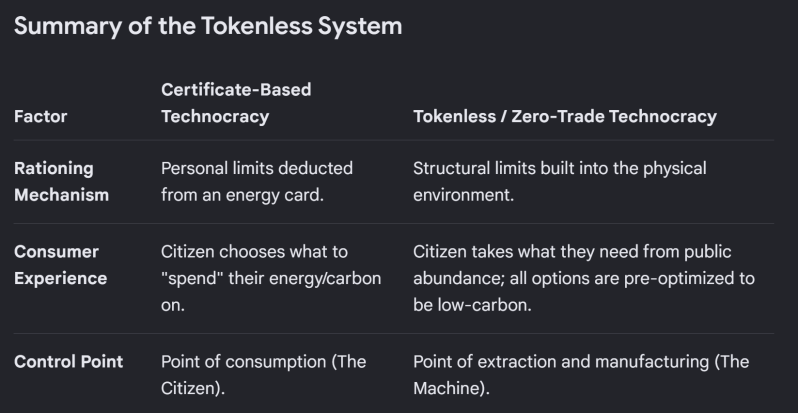
In a pure technocracy with zero tokens, trade, or credits, carbon is budgeted by engineering the human habitat. Instead of rationing the citizen, technocrats ration the industrial machine. By physically limiting the extraction of carbon-bearing materials at the source and mathematically optimizing industrial workflows, society functions safely within its ecological boundaries by structural design alone.
Manually Managed Medal System

As the Global Resource Ledger is currently offline, the medal system is being managed manually. Here is how the manually managed medal system functions:
1. The Reporting Hierarchy
In the absence of an automated sensor grid, our society must rely on a structured reporting system:
- The Workplace Ledger: Every organization (such as hospitals, farms, and factories) must maintain a "Point Log." Managers are responsible for certifying the hours worked and the sector classification of each role.
- The Regional Registry: Local government offices serve as "Medal Banks." Organizations are required to submit monthly reports, and the Registry then updates the "Citizen Card," which is a physical representation of Gold, Silver, or Bronze status.
- The Audit Council: This central body periodically reviews organizations to ensure that they are not minting more points than their physical productivity allows.
2. Managing the 90-Day Decay Curve Manually
Even in this interim phase, the regional registries and the citizens' digital wallet apps are running on localized databases. Because every single point is minted with a precise cryptographic timestamp metadata tag, each individual point can decay on its own, automatically, without requiring human intervention or a global network connection:
1. The Timestamp Metadata Tag
The moment a workplace manager certifies a shift, the local database doesn't just add a generic number to a balance. It mints that fraction of a point as a unique entry with an immutable metadata tag containing the exact date and hour of creation.
-
Example: An emergency medical shift logged today would be tagged with [2026-06-10 // CV-Value: 1.14].
2. The Local Ledger Trigger (The Automated Cron Job)
Every night at midnight, the Regional Registry’s local servers run an automated script (a cron job). This script scans the active spendable wallets in the district database and performs a simple calculation on every individual point entry:
Age of Point = Current Time - Timestamp
-
If the age is less than 24 months, the point remains at 100% value.
-
The exact second the age hits 24 months and 1 day, the local script automatically flags that specific point entry and triggers its individual 90-day decay slope.
3. Continuous Daily Bleeding (1.11% Per Day)
To make the automation smooth rather than a jerky monthly drop, the script reduces the value of that specific expired point by 1.11% every single day (33.3% divided by 30 days).
-
Your digital wallet app reads this database data in real-time. On your screen, you would see your spendable point balance slowly and fluidly ticking downward, digit by digit, if you hold expired, unredeemed points.
4. The First-In, First-Out (FIFO) Shield
Because the software is automated, the wallet app inherently protects you by applying a First-In, First-Out protocol whenever you redeem your points for a Silver or Gold card. The local database will always grab your oldest tagged points first to build the card, effectively saving them from ever touching the decay clock.
3. Point Velocity Tiers for Students
Students log their training hours exactly like an industrial shift, with points awarded determined by the nature of their study:
-
The Academic Baseline (Equilibrium Velocity — ~0.057 pts/hr): Applicable to classroom learning, lectures, and virtual reality simulators. A student studying advanced material synthesis or public health administration in a dedicated academy logs their hours to secure a steady path toward a Silver Card while completing their certifications.
-
The Critical Apprenticeship (Critical Demand Velocity — ~0.114 pts/hr): The moment a student enters active field training—such as a surgical residency, on-site structural drone calibration, or emergency grid repair apprenticing—their velocity scales up. They are absorbing risk and providing auxiliary hands on the ground, so they earn at the peak rate, accelerating their journey toward a Gold Card.
The Mutual Incentive Loop (Student + Mentor)
The ledger tracks the student's progress to ensure both the student and the mentor are rewarded cleanly:
-
During Training: The student logs hours via the Workplace Ledger of the academy or hospital, signed off by their instructor. The student receives 100% of their earned points directly into their spendable wallet and lifetime tracker.
-
Upon Graduation: The student transitions into employment status, unlocking independent project logs.
-
The Residual Activation: The exact second the graduate student logs their first independent shift, the ledger activates the 5% residual bonus to the mentor's lifetime ledger. This bonus is entirely newly minted value—it is never deducted from the student’s earnings.
4. The "Hybrid" Transition Strategy
To implement this system effectively, we will adopt a "Digital-Manual Hybrid" approach:
- Standardised Software: All organisations will utilise the same government-issued application to track labour.
- Public Transparency: The ledger will be public, allowing everyone to see how many points each individual has earned. For example, if a janitor receives an unexpected 200 points in a year, the community has the ability to "flag" this for an audit.
- Appeals Court: We will establish a dedicated system where both individual citizens and worker collectives can iron out their grievances. True to the technate design, it features no lawyers, no legal jargon, and no financial settlements. It is strictly an evidence and data tribunal.