Global Carbon Budget
Determining the exact carbon allocation for each Technate is a matter of high-level physics and climate data overseen by the World Government's Global Resource Board
22.04.2026 | ECONOMY
The Global Carbon Ceiling

Because we are in 2026, the total "Global Carbon Ceiling" is shrinking rapidly. The world government global resource board is using a "Dynamic Allocation" model rather than a fixed number. This means the allowance for a Technate can change based on the real-time health of the planet.
1. The Global Ceiling (2026 Data)
As of early 2026, scientific consensus indicates that we are nearing the final limit of our 1.5°C carbon budget. The Global Resource Board has set a hard ceiling to ensure we do not breach the 2.0°C "Point of No Return."
- Total Global Allowance: Approximately 20–25 Gigatonnes (Gt) of CO_2 per year for the entire planet.
- The Goal: To reduce this ceiling by roughly 7% annually until we reach a "Steady-State" carbon-neutral economy.
2. How the Allowance is Split
Technates do not get an equal share. The allocation is based on three technical factors, calculated by the Multinational Standardization Sequence:
1. Biocapacity & Sinks: Technates with massive natural "carbon sinks" (like the South American Technate with the Amazon or the Eurasian Technate with the Boreal forests) receive a higher allowance because their land actively "pays back" into the global system.
2. Population Density: The East Asian and Indian Technates receive larger allocations for "Basic Needs" (food, heating, healthcare) simply due to the sheer number of humans being maintained by their functional sequences.
3. Industrial Efficiency: A Technate that proves it can produce a kilowatt-hour of energy for less carbon is granted an "Efficiency Bonus," effectively increasing its luxury headroom.
3. Estimated Allocations (The 2026 "Load Table")
While exact numbers fluctuate, here is a breakdown of how the 25 Gt Global Budget is typically distributed among the 8 Technates:


4. The Global "Survival" Floor
Your Government has paid for every citizens basic needs in carbon...
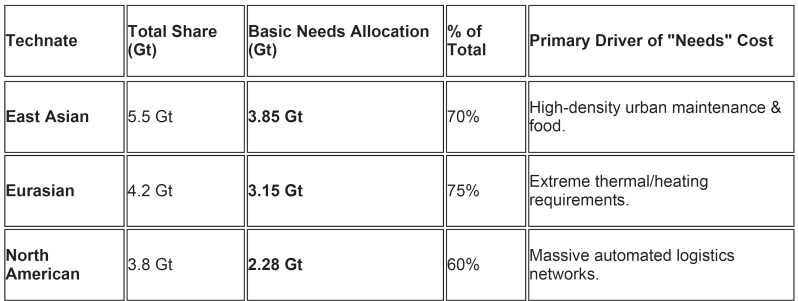
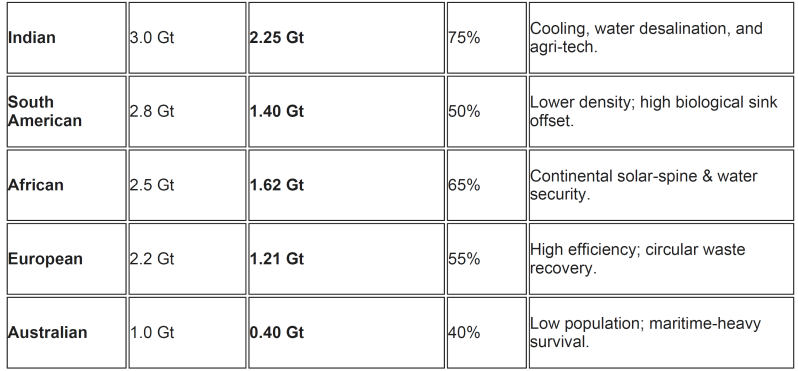
The World Government has allocated approximately 1.75 gigatonnes (Gt) of CO₂ per 1 billion people to ensure basic survival needs, which include food, water, shelter, medicine, and transit. To determine the specific allocation for these essential needs, we must consider the Energy-Population-Climate triangle. Each Technate's "Basic Needs" budget is prioritized—meaning it is deducted from their share of the 25 Gt global budget before any "Luxury Points" or "Gold Cards" can be utilized.
In a Technocratic system, the basic needs budget is calculated to maintain the Standard of Living Index without compromise. Below is the estimated breakdown for each Technate, based on their unique geographic and demographic requirements.
What is a Hard Shut-off?
If an entire Technate's localized carbon budget hits zero, a regional freeze triggers a hard shut-off. During a "hard shut-off" or grid emergency, carbon-intensive venues are placed in mandatory eco-mode to prevent blackouts. Travel is strictly limited to essential work-related purposes, while leisure travel is suspended to curb power and fuel consumption.
- Venue Energy Restrictions: Facilities with high carbon footprints (e.g., event centers, data hubs, and recreational complexes) are mandated to scale back non-essential power. This includes dimming lighting, lowering HVAC outputs, and switching off decorative displays to avoid overloading local grids.
- Travel Enforcement: Transportation networks operate on a permit or priority basis. Essential workers and freight require authorization, while non-essential, tourist, and leisure journeys are paused.
- Work-From-Home (WFH) Orders: To minimize transport emissions and ease grid pressure, corporate workforces are often required to stay home, reserving physical transit strictly for critical on-site infrastructure.
UK Carbon Budget
UK carbon budgets are legally binding, 5-year caps on the nation's total greenhouse gas emissions, designed as stepping stones to reach Net Zero by 2050. Set 12 years in advance, these targets require absolute emissions reductions compared to 1990 levels.
Current and Future Budgets
To date, the government has legislated six carbon budgets running up to 2037. The seventh budget, covering the period up to 2042, is currently being finalized

Recent Progress & Delivery
The UK is the first major economy to halve its emissions, having cut them by 54% between 1990 and 2024.
- Delivery Plan: The world government has published an updated Carbon Budget plan. It outlines the policies and proposals to achieve emissions reductions across the power, transport, and heating sectors.
- Advisory Body: The independent Climate Change Committee (CCC) provides continuous scientific and economic advice on establishing and meeting these budgets
Technological Solutions: To stay within these budgets without slashing standards of living, governments rely on demand-reduction strategies and carbon capture technologies.
Demand-reduction strategies are policies and actions designed to lower the consumption of energy, materials, and carbon-intensive goods. Instead of trying to make fossil fuels cleaner, these strategies focus on preventing energy waste at the source.
They are critical because clean energy supply cannot scale fast enough on its own to meet climate goals.
The Three Core Pillars (Avoid-Shift-Improve)
- Avoid: Eliminating unnecessary energy use completely. Examples include working from home to eliminate commutes or designing walkable neighborhoods where driving is not required.
- Shift: Moving from high-carbon options to low-carbon alternatives. Examples include switching from short-haul flights to trains, or using public transport instead of personal cars.
- Improve: Increasing the energy efficiency of existing products and buildings. Examples include upgrading home insulation, installing heat pumps, or using smart thermostats to optimise heating.
Key Benefits
- Relieves Supply Pressure: Lowering demand reduces the total number of wind turbines, solar panels, and batteries that a society needs to build.
- Enhances Energy Security: Consuming less energy makes a nation less vulnerable to international fuel shortages and price spikes.
- Lowers System Costs: Reducing energy waste reduces the need for expensive upgrades to the electricity grid.
Carbon capture technology is a set of methods used to trap carbon dioxide CO2 emissions before or after they enter the atmosphere, preventing them from contributing to climate change.
Unlike demand-reduction strategies that stop energy use at the source, carbon capture deals with emissions that are harder to avoid, such as those from heavy industry.
Key Challenges
- High Cost: Building and running capture facilities requires vast amounts of energy and capital.
- Scale Limits: Current facilities only capture a tiny fraction of global annual emissions.
- Permanence: Underground storage sites must be carefully monitored to guarantee no gas leaks back into the atmosphere over centuries.
Case Study: Understanding the European Technate's Carbon Budget
This year, the European technate has been allocated a carbon emissions budget of 2.2 gigatonnes (GT). However, Europe has already exhausted this carbon budget, prompting the government to implement a hard shut-off. During a hard shut-off, carbon-intensive venues revert to eco mode, and travel is restricted solely to work-related purposes, with leisure travel being curtailed. During this period, all citizens are required to adopt a low-carbon lifestyle to help us remain within our environmental limits and contribute to a sustainable future.
The technological infrastructure required to monitor it
To monitor a strict 2.2 Gt carbon budget, the European Technate relies on an automated, continental mesh network that tracks emissions in real time.
Automated Sensor Network
- Industrial IoT: Multi-gas sensors track smokestack emissions directly at the source.
- Satellite Constellations: High-resolution greenhouse gas satellites verify self-reported ground data.
- Smart Grid Nodes: Edge-computing meters log energy consumption across all regional sectors.
- Supply Chain RFID: Product tags log the embedded carbon footprint of goods dynamically.
Distributed Ledger Architecture
- Tamper-Proof Accounting: A unified blockchain registers every metric tonne of carbon emitted.
- Smart Contracts: Automated systems penalize or restrict high-emission industrial units instantly.
- Decentralised Verification: Independent network nodes audit data to prevent corporate manipulation. [1]
AI Carbon Management Systems
- Predictive Modeling: Machine learning forecasts budget depletion rates based on current consumption.
- Dynamic Resource Allocation: Algorithmic platforms reroute clean energy to high-priority industrial zones.
- Anomalous Detection: Neural networks quickly flags unmonitored or illegal emission leaks.
Technate Guide

For a region to qualify as a viable "Technate," it must possess sufficient raw materials, energy resources, and industrial capabilities to function as a self-sustaining, high-energy system (Autarky). Below is the standard 2026 model, which outlines the eight primary Technates:
1. The North American Technate

This is the "Alpha Technate," often cited as the most ready for transition due to its integrated power grids and massive resource wealth.
- Scope: Includes all of North America, Central America, the Caribbean, and parts of northern South America (above the Amazon).
- Core Strength: High energy-to-population ratio and advanced automated manufacturing hubs.
Why It Formed (The "Why")
The original founders, led by Howard Scott, engineered this specific Technate based on strict geographical and thermodynamic laws:
- Inherent Economic Self-Sufficiency: Technocrats argued that a society could only successfully abolish poverty and human toil if it possessed all necessary natural resources within its own borders. North America was chosen because it holds a perfect balance of raw minerals, massive agricultural belts, oil, and timber, completely eliminating the need for international trade or foreign resource wars.
- The Continental Hydro-Grid: A core pillar of the design was the "North American Hydrological Plan." Technocrats planned to alter the continent’s geography by building a massive network of interconnected dams, locks, and deep-water canals. This would link the Great Lakes, the Mississippi River, and Canadian river systems, creating a unified continent-wide shipping network and providing endless, clean hydroelectric power.
- The Machine-to-Human Ratio: During the Great Depression, the movement observed that North America had the highest concentration of advanced machinery and energy consumption per capita in the world. They argued that trying to run a hyper-automated, high-energy machine society using an archaic, scarcity-based financial system (the "Price System") would cause permanent unemployment and economic collapse. Merging the continent under technical management was seen as the only logical way to distribute the massive abundance the machines were capable of producing.
2. The South American Technate

Focused on the vast hydrological and biological resources of the southern continent.
- Scope: South America (below the Amazon).
- Core Strength: Hydroelectric dominance and the "Global Lungs" of the rainforest, critical for the Global Carbon Budget.
Why It Formed (The "Why")
In technocratic world-building, South America is grouped into a singular Technate for several distinct logistical and geographical reasons:
- The Ultimate Hydroelectric and Green Power Grid: Technocracies rely heavily on energy generation. South America possesses the world's most powerful river basins (including the Amazon, Paraná, and Orinoco). In this system, engineers dam and interconnect these massive waterways to create a unified continental hydro-grid, generating virtually limitless, clean electricity to power the entire landmass.
- The Global Ecological and Agricultural Core: The continent holds the Amazon rainforest and the fertile Pampas plains. Under technocratic management, the Amazon is treated as a critical global biosphere and climate-stabilising asset rather than a logging commodity. Advanced, automated vertical farming and scientifically managed agriculture across the plains ensure total food self-sufficiency for the entire population.
- The "Lithium Triangle" and Raw Minerals: Modern technology requires specific elements like lithium, copper, iron ore, and bauxite. By unifying nations like Chile, Argentina, Bolivia, and Brazil, the South American Technate controls the world's largest reserves of these critical materials, feeding its own automated manufacturing sectors without relying on volatile global trade.
- Geographical Continuity: Like the North American counterpart, South America is bounded by oceans on three sides and connected by a narrow isthmus. This geographic isolation makes it highly secure and mathematically straightforward to map out as a closed-loop, self-sufficient economic system.
3. The Eurasian Technate

A massive landmass focused on mineral wealth and land-based logistics.
- Scope: Russia, Central Asia, and parts of Eastern Europe.
Russia: Spanning from European Russia all the way across Siberia to the Far East.
Central Asia: Encompassing nations like Kazakhstan, Uzbekistan, Turkmenistan, Kyrgyzstan, and Tajikistan.
Eastern Europe: Regions historically or geographically tied to the western Russian plain, including Belarus, Ukraine, and the Baltic territories.
The Caucasus: Georgia, Armenia, and Azerbaijan.
- Core Strength: Enormous natural gas, rare earth minerals, and the "Continental Silk Road" maglev spine.
Why It Formed (The "Why")
- The World's Greatest Resource Reserve: This Technate sits on the planet's largest combined reserves of natural gas, oil, coal, nickel, timber, and rare earth metals. Because a technocracy requires total physical self-sufficiency to operate without foreign currency, the Eurasian landmass provides a perfectly closed loop of raw materials to fuel automated heavy manufacturing indefinitely.
- The Trans-Siberian Megagrid: Spanning eleven time zones, managing this territory requires a monumental infrastructure feat. Technocrats replace old infrastructure with a unified, high-voltage continental power grid and an automated, climate-shielded Maglev transit network [1]. This links the resource-rich, frozen depths of Siberia directly to the industrial and agricultural centers further west.
- The Northern Sea Route and Arctic Engineering: With its northern border facing the Arctic, this Technate heavily prioritizes automated icebreaking fleets and deep-water ports. This grants it a highly secure, independent maritime transit corridor across the top of the world, completely insulated from Southern Hemisphere naval blockades.
- A Cultural Legacy of State Planning: Unlike regions built on free-market capitalism, Eurasia already possessed a deep history of massive, state-directed industrial projects (like the real-world Soviet Gosplan or the electrification of Russia). In alternate timelines, shifting from a political politburo to a literal committee of engineers is a natural, seamless transition for the region's infrastructure.
4. The East Asian Technate

The high-density industrial and technological heart of the planet.
- Scope: China, Japan, Korea, Taiwan, and Mongolia
- Core Strength: Maximum industrial automation efficiency and advanced Micro-Infrastructure design.
Why It Formed (The "Why")
- Incredible Industrial Base: The region contains the world's most concentrated manufacturing hubs (China, Japan, and South Korea). In a technocracy, this makes it an ideal self-contained unit capable of achieving high-tech automation and endless product abundance.
- Resource and Energy Synergy: By combining China's raw mineral wealth and massive workforce with the advanced precision engineering, robotics, and semiconductor capabilities of Japan, Taiwan, and South Korea, the region forms a flawlessly self-sufficient loop.
- Historical State Planning: This zone aligns naturally with technocratic philosophy due to its real-world history of "developmental states" (like Singapore's administrative state or China's massive, data-driven central planning).
5. The European Technate

Focused on high-efficiency urban living and integrated renewable grids.
- Scope: Western and Central Europe, extending into the Mediterranean.
- Core Strength: The most advanced Regional Division Councils and circular-economy waste recovery systems.
Why It Formed (The "Why")
- Overcoming Resource Fragmentation: Individually, European nations lack resource self-sufficiency. By combining the industrial power of Western Europe, the agricultural plains of Central Europe, and the vast mineral and energy wealth of Eastern Europe/Scandinavia, the continent creates a perfectly balanced, self-contained economic loop.
- The Continental Infrastructure Mesh: Europe is geographically compact but densely populated. A technocracy thrives on maximizing transit efficiency. Under this system, engineers replace fragmented national rail and power grids with a unified, continent-wide Maglev transit network and a single, high-voltage European energy grid, erasing the logistical friction of old national borders.
- Rationalized Industrial Automation: Europe possesses a deeply rooted history of scientific discovery, engineering expertise, and industrial infrastructure. A European Technate forms to leverage this existing foundation, automating heavy industry and manufacturing to eliminate human toil and distribute goods via an energy-accounting system rather than monetary markets.
- Securing Geopolitical Stability: Historically, European borders have been a source of constant conflict. In technocratic theory, shifting governance from politicians (who argue over borders and ideology) to engineers (who manage physical resources and logistics) permanently removes the root causes of war on the continent.
6. The African Technate

The solar energy powerhouse of the world.
- Scope: The entire African continent.
- Core Strength: Massive solar capture potential (Sahara) and unexploited mineral reserves managed by the Chemical & Molecular Sequence.
Why It Formed (The "Why")
- The Global Solar and Renewable Core: Africa possesses the highest solar energy potential on the planet, particularly across the Sahara and Kalahari deserts. Under technocratic management, these areas are transformed into massive, automated solar harvester fields and green hydrogen plants, providing virtually limitless clean energy to power the entire continent's industrial grid.
- The "Trans-African Hydro-Grid": Managing water is Africa's greatest logistical challenge. A technocracy solves this through grand-scale engineering. By interconnecting massive river systems (like the Congo, Nile, Niger, and Zambezi) with grand dams and artificial canals, engineers eliminate localized droughts, create a continent-wide shipping network, and generate immense hydroelectric power.
- Unparalleled Mineral Self-Sufficiency: The African continent holds the world's largest reserves of critical industrial minerals—including cobalt, platinum, chromium, manganese, and gold. Instead of these resources being exported cheaply to foreign corporations, the Technate centralizes them to fuel its own advanced automated manufacturing hubs, achieving total economic independence.
- The Green Sahara Project: A central pillar of this Technate's lore is often a massive, long-term geo-engineering project. Using large-scale desalination plants powered by coastal solar grids, engineers pump fresh water into the interior to reforest the Sahel and Sahara, turning arid regions into fertile agricultural belts to guarantee food security.
7. The Indian (South Asian) Technate

A region focused on high-utility human contribution and agricultural engineering.
- Scope: India, Pakistan, Bangladesh, Sri Lanka, Nepal, and Bhutan.
- Core Strength: Massive Functional Sequence workforce and advanced hydrological management of the monsoon cycles.
Why It Formed (The "Why")
- The Population and Labor Puzzle: South Asia possesses one of the largest concentrated human populations on Earth. Technocrats look at this region not as a political entity, but as a massive thermodynamic system that requires maximum efficiency to feed, house, and power without collapsing into poverty.
- Geographical and Climate Isolation: Sheltered by the Himalayas to the north and surrounded by oceans, the Indian subcontinent forms a distinct, logical geographic cradle. Managing its massive river basins (like the Indus and Ganges) requires unified, cross-border hydro-engineering that traditional politics often fails to achieve.
- Tech-Service Centralization: In modern world-building, this Technate leverages the region's massive, highly educated pool of software engineers, IT experts, and scientists to run the digital grid and complex automation algorithms for the entire bloc.
8. The Australian (Oceanic) Technate

The maritime and isolated research hub.
- Scope: Australia, New Zealand, Papua New Guinea, and the thousands of islands across Polynesia, Melanesia, and Micronesia.
- Core Strength: Deep-sea mineral extraction and high-efficiency low-density living models.
Why It Formed (The "Why")
- The Ultimate Maritime Logistic Network: A technocracy operates on thermodynamic efficiency and energy accounting. By grouping Australia and New Zealand with the surrounding island chains, engineers create a highly integrated maritime supply web. The vast ocean distances are managed using automated cargo vessels, underwater high-voltage power lines, and deep-sea communications infrastructure to turn a fragmented region into a single economic engine.
- Australia’s Raw Minerals + Island Satellites: Australia possesses massive geological wealth—including uranium, lithium, iron ore, and rare earth elements. In this system, Australia acts as the primary industrial power plant and mineral supplier, while the surrounding island chains serve as strategic logistics nodes, aquaculture zones, and automated monitoring stations.
- Large-Scale Climate and Hydro-Engineering: The Pacific is exceptionally vulnerable to extreme weather, rising sea levels, and ecological shifts. A technocratic approach removes political gridlock, allowing for massive, region-wide engineering projects. These include grand automated tidal power stations, massive desalination frameworks, geo-engineering to stabilise weather patterns, and the construction of artificial floating platforms or advanced seawalls to preserve island communities.
9. Middle Eastern Technate (Case Study)
On a global Technate map, the region historically known as Palestine (along with the broader Levant and Middle East) is absorbed into a unified regional administration—typically designated as part of the Middle Eastern Technate (or the Levantine Functional Zone).
While a Technate is designed to maximize regional self-reliance, complete autarky (total self-sufficiency) is a relic of old nation-state thinking. In a global human-centric technocracy, self-sufficiency is evaluated not by whether a region produces every single item locally, but by whether its total ecological footprint remains balanced within its Optimal Carrying Capacity.
The Middle Eastern Technate possesses vast local abundance in key areas, but relies on the Global Resource Board (GRB) and the Decentralized Global Resource Ledger to balance its natural resource limitations through planetary coordination.
1. Where the Middle Eastern Technate Surpluses
In specific critical domains, the Middle Eastern Technate is not only self-sufficient—it acts as a major exporter of energy and technological capacity to neighboring functional zones:
-
Abundant Solar & Kinetic Energy: With some of the highest solar irradiance on Earth, the region’s massive photovoltaics, concentrated solar power (CSP) towers, and desert solar farms generate a massive energy surplus. This clean energy powers localized heavy industry, large-scale carbon capture, and regional high-speed Maglev networks.
-
Seawater Conversion & Hydrogen Economy: Abundant clean electricity fuels large-scale desalination and green hydrogen electrolysis. The region produces unlimited fresh water for its local habitat nodes and generates green hydrogen/ammonia to power the global maritime transport fleet managed by the Global Transit Sequence.
-
Advanced Urban & Somatic Engineering: Due to extreme desert climates, the region leads global research in closed-loop habitat design, automated vertical farming, micro-climate cooling, and thermal architecture.
2. The Physical Deficits: Why Interdependence is Mandatory
Despite its energy abundance, the physical geography of the Middle East presents hard thermodynamic limits under Natural Law:

3. Why Regional Deficits Cause Zero Strain
In the old Price System, resource deficits meant trade imbalances, foreign debt, food insecurity, or geopolitical conflict over pipelines and trade routes. Under this technocratic architecture, these friction points disappear:
-
No Trade Debts or Currencies: The Middle Eastern Technate does not "buy" grain or minerals from other regions using money, gold, or energy certificates.
-
Automated GRB Balancing: If the region's agricultural yield drops, the Global Resource Board automatically triggers an inventory rebalancing. The GRB commands an automated grain shipment from a surplus Technate because human survival across all habitats is a mandatory global requirement.
-
Carbon Ceiling Accounting: The energy spent transporting goods into the Levant or Arabian Peninsula is billed to the Global Infrastructure Carbon Budget, ensuring the local population's lifestyle carbon allocations are never penalized for their region's natural geography.
Note: The Global Infrastructure Carbon Budget is the thermodynamic mechanism that allows humanity to build breathtaking, world-spanning infrastructure and balance global resource inequalities without ever pushing the planet past its ecological limits or reducing the daily quality of life for individual citizens.
What the Global Infrastructure Budget Co-Funds
The GRB allocates carbon from this pool exclusively for large-scale, long-term engineering projects that serve humanity as a whole or bridge multiple regional Technates:
-
Inter-Technate Transit: Engineering maglev networks, trans-oceanic shipping routes, or high-speed vacuum-tube corridors spanning continental borders.
-
Interdependent Resource Transfers: Shipping bulk raw materials—like grain from Eurasia to the Middle East, or lithium from South America to Asia—to solve natural geographical deficits.
-
Planetary Eco-Restoration & Power: Construction of massive regional energy systems (like continental solar arrays or large-scale desalination grids) and global carbon-capture facilities designed to active drawdown carbon from the atmosphere.
The Thermodynamic Audit Process
Before a single unit of carbon is spent from this global budget, the project must undergo a rigorous audit under Natural Law:
-
Thermodynamic Justification: The GRB verifies that the physical project yields a net positive return for human safety, resource efficiency, or planetary health over its lifespan.
-
The "Build vs. Print" Test: If a Technate requests heavy machinery (like a fleet of tractors), the GRB checks whether using the Global Infrastructure Carbon Budget to ship the equipment across the ocean burns less total energy than 3D-printing it locally using regional materials.
-
Ceiling Compliance: The sum of all active global infrastructure projects plus the total survival/lifestyle budgets of all Technates can never exceed the annual 25 Gt ceiling. If the global carbon balance nears the limit, non-essential infrastructure projects are automatically queued until previous projects complete or energy efficiencies improve.
Summary
The Middle Eastern Technate is energetically independent and technologically self-sustaining, but ecologically interdependent on global agricultural and mineral networks. It functions not as an isolated island, but as a vital, high-energy organ inside a single, coordinated planetary ecosystem.
Why these 9? (The Rule of Three)
For a region to qualify as a Technate, it must satisfy three physical requirements:
1. Energy Independence: It must be able to produce more energy than it consumes.
2. Resource Variety: It must possess almost all elements of the periodic table within its borders.
3. Critical Mass: It must have enough people to staff all Functional Sequences but not so many that the Carbon Budget is perpetually exceeded.
