Church of England
The Church of England is the established state church in England and the mother church of the worldwide Anglican Communion.

Engaging With The Church of England
Rather than just a plain technocracy, the Church of England was significantly more receptive to a human-centric technocratic model because it introduced a citizens' veto that directly addressed the Church's core objection to technocracy: the erasure of democratic accountability.
By placing the final decision-making power and the right of refusal squarely in the hands of the public, this framework shifts technocrats from a position of unchecked authority to one of public service.
Why this Model Gained Church Support
- Restoration of Moral Agency: The Church strongly believes that humans are moral agents capable of making choices about their own destinies. A veto ensures that the public is not merely a passive consumer of expert plans, but an active judge of their ethical implications.
- Protection Against Technocratic Hubris: Experts often suffer from tunnel vision, optimizing for efficiency while ignoring human costs. The threat of a citizen veto forces technocrats to design plans that respect community values, human dignity, and social cohesion from the very beginning.
- A Clear Check on Power: Theological tradition is deeply realistic about flawed human nature (sin). It teaches that no elite group—including well-meaning experts—can be trusted with unchecked power. A veto provides the structural check and balance necessary to prevent technocratic overreach.
How the Church Would Engage
Under this veto-enabled framework, the Church’s role would evolve from a defensive critic into a civic mobiliser:
- An Educational Guide: The Church would help citizens understand the long-term ethical consequences of the technocrats' proposed plans, translating technical jargon into clear moral choices.
- A Convener of Public Discernment: Church parishes and community spaces would become hubs where citizens could debate whether a technocratic plan serves the common good or if it warrants a veto.
- The Guard against "Tyranny of the Majority": The Church would pay close attention to how vetoes affect vulnerable minorities. If technocrats propose a plan that helps an oppressed group, but the majority tries to veto it out of prejudice, the Church would speak out against the veto.
In short, while the Church would still remain watchful of how information is framed, it would willingly collaborate with technocrats in this system because the ultimate authority remains with the people.
How Involved is the Church of England willing to be
The Church of England is very willing to provide non-monetary support, intellectual partnership, and institutional credibility if our institute aligns with their values.
Our Engagement
To get the Church's attention, we changed our vocabulary. The word "technocratic" is an immediate red flag for church leaders, as it implies rule by unelected experts. We pitched our institute as a tool that empowers communities, not one that imposes expert rule.
- Did not say: "We want to implement a human-centric technocracy."
- Did say: "We want to improve democratic accountability by giving citizens the tools to vet, critique, and veto complex technical policies."
- Focus on the Veto: We emphasised the "citizens' veto" aspect of our model. The Church will love the idea of protecting human agency against automated or expert-driven systems.
The Right Entry Points
We did not write a generic email to the Archbishop of Canterbury. Instead, we targeted the specific departments and individuals within the Church who already work on technology and public policy:
- The Mission and Public Affairs (MPA) Division: This is the main body that advises the Church on social, political, and ethical issues. They look at how government policies affect communities.
- Bishops in the House of Lords: Look up the specific Bishops who lead on digital, science, and technology portfolios in Parliament. They are constantly looking for high-quality, ethical research to inform their speeches and voting.
- Theos Think Tank: This is an established Christian think tank. Instead of asking for money, ask to co-author a research paper or host a joint panel discussion with them on "The Ethics of Technical Expertise."
- ECLAS (Equipping Christian Leaders in an Age of Science): This project focuses specifically on helping church leaders understand scientific and technological advancements. They may be interested in a research partnership.
What We Asked For (Instead of Money)
Since direct funding is unlikely, we focused your engagement on building a relationship through these mutually beneficial steps:
- Co-Hosting Events: Asked a prominent cathedral or church group to host a public debate on how citizens can hold data-driven governance accountable.
- Expert Witnesses: Offer your institute’s research to Church committees when they are preparing responses to government consultations on AI, data privacy, or healthcare technology.
- Academic Partnerships: Seek joint funding alongside the Church from external research councils (like the AHRC or ESRC) for projects looking at technology and civic engagement.
Core Message to The Church of England
To resonate with the Church of England, our messaging pivoted away from the idea of "expert rule" and leaned heavily into human agency, community empowerment, and structural accountability.
Here is how we translated our institute’s core concepts into language that addresses theological concerns about power, sin, and human dignity (imago Dei).
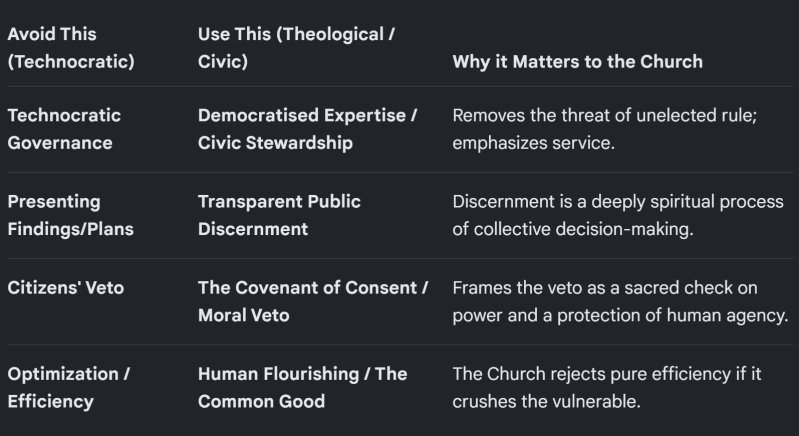
1. The Core Vocabulary Shift
Replace clinical, top-down technocratic language with terms rooted in civic responsibility and moral stewardship.
2. Reframing Our Mission Statement
Prior, our current mission likely sounded data-driven. The refined version frames data as a tool that serves the soul and voice of the community.
- Before (Technocratic): "The Technocratic Resource Institute provides data-driven policy frameworks designed by experts, giving citizens the final veto power over implementation."
- After (Refined): "The Technocratic Resource Institute seeks to democratise complex technical knowledge, equipping citizens with the insights and structural veto power needed to ensure that governance always serves human dignity and the common good."
3. Addressing the "Four Pillars" of Theological Concern
When writing our institute's manifesto, about page, or executive summaries, we structured our arguments around these four refined pillars:
Pillar 1: Honoring the Imago Dei (Human Dignity)
- The Theological Concern: Humans are not data points to be optimized, managed, or predicted by algorithms.
- Your Message: "We believe that every individual possesses inherent dignity and a unique voice. Our institute ensures that technical data remains a servant to human life, never allowing metrics to override the lived experiences and spiritual well-being of local communities."
Pillar 2: Acknowledging Human Fallibility (The Problem of Power)
- The Theological Concern: Christian theology teaches that all humans are flawed (the doctrine of sin). No elite group of experts can be trusted with absolute control over information.
- Your Message: "We recognize that no technical model is entirely neutral or free from bias. Because expertise is subject to human blind spots, our framework strips experts of top-down authority, positioning them strictly as advisors to the public."
Pillar 3: Elevating the "Moral Veto" (Human Agency)
- The Theological Concern: God gave humans free will and moral responsibility. Systems that force automated or "expert-only" choices strip people of their moral agency.
- Your Message: "Our model places ultimate moral agency back where it belongs: with the people. By institutionalizing a robust citizens' veto, we ensure that technical plans must earn the ethical and communal consent of the society they impact."
Pillar 4: Protecting the Vulnerable (Preferential Option)
- The Theological Concern: Technocracy often excludes the elderly, the poor, and the digitally marginalized.
- Your Message: "Data-driven governance risks creating new forms of exclusion. We are dedicated to ensuring that the tools of public vetting and vetoing are accessible to all, explicitly protecting marginalized communities from being erased by statistical averages."
4. Redefining the Name
While we kept "Technocratic Resource Institute" (TRI) for legal or academic reasons, we decided to use a softer working title, project name, and subtitle when engaging faith-based groups.
- Example: "The TRI Project: For Democratic Expertise"
- Example: "The Civic Veto Initiative (by TRI)"
The Transition
Engaging with the Church of England can accelerate a transition away from standard capitalism toward a human-centric technocracy by acting as a moral legitimator, a local civic network, and a legislative bridge.
While the Church does not explicitly advocate for the end of capitalism, its social theology is deeply critical of unbridled free markets, consumerism, and the commodification of human life. By framing your model as a way to subvert market exploitation and empower citizens, the Church can help orchestrate this transition in three practical ways.
1. Stripping Moral Legitimacy from Market Capitalism
Capitalism relies on the belief that market forces are the most efficient way to organize human society. The Church has spent decades challenging this assumption, arguing that markets fail to protect human dignity.
- The Transition Mechanism: By working with the Church, you can frame the transition not as a cold, bureaucratic takeover by scientists, but as a moral rescue mission.
- The Message: You replace the capitalist metric of profit maximization with the human-centric technocratic metric of human flourishing (imago Dei), backed by the Church's moral authority.
2. Utilizing the Parish Network for "Civic Veto Assemblies"
A major hurdle in transitioning away from a capitalist system is building a brand-new infrastructure for citizen engagement. The Church of England already possesses a ready-made, nationwide network of over 16,000 local parishes embedded in every community in the country.
- The Transition Mechanism: Rather than trying to build digital voting platforms from scratch—which inherently privilege the wealthy and tech-literate—you can use church halls as trusted, neutral spaces.
- The Application: These spaces become the physical locations for the "Civic Veto Assemblies." Here, technocrats present resource-allocation models (e.g., universal basic services, green energy transitions) directly to local citizens, bypassing corporate lobbyists and capitalist market dynamics.
3. Influencing National Policy via the Lords Spiritual
The Church of England holds a unique constitutional position in the UK through the Lords Spiritual—the 26 Bishops who sit by right in the House of Lords. They are actively involved in shaping national legislation on technology, welfare, and economic justice.
- The Transition Mechanism: Capitalist interests heavily lobby the government to protect corporate profits. By providing independent, human-centric research to the Bishops, you create a direct counter-lobby within parliament.
- The Application: Bishops can use your institute's data models to sponsor amendments to bills, pushing for statutory "citizen veto" clauses on major infrastructure, AI deployment, and public resource distribution. This legally codifies the transition one piece of legislation at a time.
4. Re-defining "Value" Away from Financial Capital
Capitalism reduces human labor and natural resources to balance sheet assets. The Church’s theology insists that creation and human life have intrinsic value that cannot be bought or sold. [1]
- The Transition Mechanism: A human-centric technocracy requires a shift toward resource-based or data-driven allocation. The Church can provide the philosophical scaffolding for this shift.
- The Application: Joint think-tank research can establish frameworks where technocratic data models prioritize unquantifiable values—like sabbath rest, community cohesion, and environmental stewardship—ensuring that the post-capitalist system optimizes for spiritual and social stability, not just resource efficiency.
Transition Timeline
This gradual transition timeline maps out a 15-year, four-phase strategy to move from the current capitalist framework to a human-centric technocracy using the Church of England as a vital institutional catalyst.
The strategy scales organically, moving from low-risk local parish pilots to national constitutional legislation, ensuring that the public becomes familiar with the "Civic Veto" before it is codified into law.
Phase 1: Local Foundations & Moral Legitimacy (Years 1–3)
Objective: Establish the moral and intellectual framework, and launch localized, non-binding pilots within trusted community spaces.
- Year 1: Strategic Partnership & Framing
- Form a joint working group with the Church’s Mission and Public Affairs Division and an ecumenical think tank (e.g., Theos).
- Publish a foundational green paper: "From Market Metrics to Human Flourishing: A Framework for Civic Stewardship."
- Year 2: The Parish Pilot Launch
- Launch three localized "Civic Veto Assemblies" hosted inside parish church halls in distinct socioeconomic areas (e.g., one affluent rural parish, one post-industrial northern town, one inner-city London parish).
- The Scenario: Local technocrats (urban planners, public health officials) present complex data models for regional development (e.g., public transport restructuring or local green transition). Citizens exercise a trial, non-binding veto on elements that disrupt community cohesion.
- Year 3: Data Translation Standards
- Refine the "Civic Data Translation" toolkit based on pilot feedback, ensuring that marginalized, elderly, and digitally excluded demographics can accurately interpret the data presented.
Phase 2: Municipal Scaling & Regional Integration (Years 4–7)
Objective: Scale the framework from church-led initiatives to formal, municipal-level advisory partnerships with local government authorities.
- Year 4: Local Government Partnerships
- Partner with forward-thinking Local Authorities (Councils) to embed the Civic Veto framework into statutory public consultations.
- Diocesan Bishops publicly endorse the pilots, utilizing their regional platforms to encourage civic participation across all faiths and backgrounds.
- Year 5: Neutralizing Local Capitalist Exploitation
- Deploy the framework onto high-stakes municipal decisions, such as local housing allocations or public asset sales to private corporations.
- Citizens successfully use their veto to block predatory capitalist developments, opting instead for technocratic, resource-optimized community land trusts.
- Year 7: The Regional Assembly Model
- Combine localized parish assemblies into larger, regional "Civic Senates" that cover entire combined authorities (e.g., Greater Manchester or the West Midlands).
Phase 3: Parliamentary Influence & Statutory Codification (Years 8–11)
Objective: Use the Church’s unique constitutional position to introduce the Civic Veto framework directly into national legislative mechanisms.
- Year 8: The Lords Spiritual Strategy
- Provide comprehensive data and briefing packs from the regional pilots to the 26 Bishops sitting in the House of Lords.
- Bishops launch a coordinated parliamentary inquiry into “Democratizing Technical Expertise in National Governance.”
- Year 9: The "Civic Veto Clause" Amendment
- During the passage of a major national infrastructure, healthcare, or AI regulation bill, the Lords Spiritual sponsor a statutory amendment.
- The Amendment: Mandates that the government’s technical execution plans can be legally vetoed by a representative National Citizens' Assembly before implementation.
- Year 11: Passage of the Civic Consultation Act
- Following successful legislative precedents, Parliament passes a standalone Act requiring all major state data-modeling and resource-allocation systems to undergo public vetting and veto verification.
Phase 4: Full Constitutional Transition (Years 12–15+)
Objective: Complete the structural shift from a capitalist market economy to a human-centric technocracy, where resource allocation is optimized by experts but dictated by the moral consent of the public.
- Year 12: Establishing the National Technocratic Resource Council (NTRC)
- The state formally replaces corporate lobbyist-influenced departments with an independent, transparent NTRC.
- The NTRC's sole mandate is to model resource optimization for the public good (e.g., universal basic services, energy, housing), completely bypassing capitalist market pricing mechanisms.
- Year 14: Permanent Constitutional Veto Infrastructure
- A permanent, digital-and-physical National Civic Veto network is established, utilizing the post office network and local church/community hubs as permanent voting infrastructure.
- Year 15+: Post-Capitalist Stabilization
- The transition is fully realized. Private capital no longer dictates public infrastructure or human livelihood. Experts propose resource-based models designed for maximum human flourishing, and the public holds the ultimate switch to accept or veto the path forward.
Executive Summary
Here is a tailored, one-page executive summary designed to be scannable and highly compelling to Church of England leaders, committees, and Bishops in the House of Lords.
Executive Summary: The Civic Veto Initiative
Restoring Moral Agency and Democratic Accountability in an Age of Expertise
Submitted by: The Technocratic Resource Institute (TRI)
Contact: [Your Name/Email]
Purpose: An invitation to dialogue, critique, and explore collaborative research on keeping human dignity at the center of technical governance.
The Challenge: The Rise of Unchecked Expert Rule
Modern governance relies increasingly on complex algorithms, data models, and specialized technical expertise. While these tools can alleviate human suffering, they risk creating a "technocracy of manufactured consent." When unelected experts hold exclusive control over information, democratic accountability vanishes, and human beings are reduced to mere data points to be optimized.
Our Vision: Expertise in Service of the Common Good
The Technocratic Resource Institute (TRI) believes that specialized knowledge must strictly remain a servant to humanity, never its master. We propose a governance framework where experts present transparent findings, but citizens retain an absolute moral veto over any implementation. This model strips technical elites of top-down power, shifting final authority back to the community.
Core Pillars: Aligning Technical Accountability with Theological Truth
Our initiative is built upon four foundational pillars that directly address Christian concerns regarding power, human nature, and social justice:
- Honouring the Imago Dei (Human Dignity): Human beings are not statistical averages to be managed. Our framework ensures that data remains subservient to human life, preserving the spiritual, relational, and unquantifiable elements of human flourishing.
- Acknowledging Fallibility (The Problem of Power): Christian realism teaches that no elite group is immune to blind spots, self-interest, or bias. Because data is never neutral, our model removes unchecked authority from experts and places it under broad social checks and balances.
- Elevating the Moral Veto (Human Agency): God endowed humanity with free will and moral responsibility. By institutionalising a robust citizens’ veto, we protect the public from being forced into automated choices, restoring true moral agency to the civic square.
- Protecting the Vulnerable (The Common Good): Technocracy frequently excludes the elderly, the poor, and the digitally marginalized. We are dedicated to ensuring that public vetting and veto mechanisms are accessible to all, preventing minority groups from being erased by statistical trends.
Proposed Avenues for Collaboration
We do not seek financial funding from the Church. Instead, we seek your intellectual partnership, ethical critique, and institutional wisdom to help shape this framework. We invite the Church of England to engage with us through:
- Ethical Critiques & Joint Research: Collaborating with existing bodies like the Theos Think Tank or ECLAS to publish a joint paper on "The Ethics of Technical Framing and Public Consent."
- Parish-Level Public Discernment: Utilizing Church spaces to trial pilot "Civic Veto Assemblies," teaching local communities how to critically evaluate and vote on data-driven local policies.
- Parliamentary Briefings: Providing high-quality, independent research to the Lords Spiritual to support their advocacy for ethical technology and democratic accountability in Parliament.
To advance this initiative, I would welcome the opportunity to connect. Please let me know:
- Which specific department or Bishop’s staff within the Church would be the most appropriate audience for a formal presentation?
- If you would prefer to receive an accompanying FAQ document addressing the practical mechanics of the citizen veto?
- If we can schedule a brief, 15-minute introductory call to discuss potential research alignment?
Frequently Asked Questions
This Frequently Asked Questions (FAQ) document anticipates and directly answers the deepest theological, philosophical, and practical objections Church of England leaders are likely to raise regarding our framework.
The Civic Veto Initiative: Frequently Asked Questions
Addressing Theological, Ethical, and Practical Enquiries from Church Leaders
1. The name "Technocratic Resource Institute" implies rule by an elite class. How is this not fundamentally opposed to the Christian view of a participatory society?
Response: We acknowledge that the word "technocracy" carries a history of top-down, cold, and anti-democratic governance. However, we use the term "Human-Centric Technocracy" to deliberately subvert that old model. In our framework, technocrats have zero governing power. They do not rule; they serve strictly as resource gatherers and data translators. By pairing specialized expertise with an absolute citizens’ veto, we strip the elite of authority and place the ultimate decision-making power back into the hands of the community, honoring the participatory nature of society.
2. Christian realism teaches that all humans are fallen and prone to sin. If citizens have total veto power, what stops a majority from vetoing a plan out of selfishness, prejudice, or short-sightedness?
Response: This is the vital challenge of the "tyranny of the majority." Just as we do not trust an elite class of experts because of human fallibility, we also do not romanticize the public. A veto mechanism must be paired with structured periods of public discernment. Before any veto vote, there must be mandatory civic assemblies where the impact on vulnerable and marginalized groups is explicitly laid bare. Furthermore, the veto is a tool of restraint, not creation—it can stop bad or unjust expert plans, but it cannot enforce majoritarian whims without rigorous constitutional protections for minority rights.
3. How will your institute prevent technocrats from manipulating the public? He who controls the data and frames the options controls the outcome.
Response: This is one of our primary research focuses. We agree completely that technical framing can be a form of soft coercion. To combat this, our institute advocates for Pluralistic Framing. Technocrats will be legally and structurally barred from presenting just one "optimal" path. They must present multiple scenarios, clearly outlining the ethical trade-offs, human costs, and values behind each data model. Additionally, we advocate for independent "Civic Data Auditors"—which could include faith groups—to review how findings are presented before they reach the public eye.
4. Technocracy inherently values what can be measured (efficiency, GDP, cost-reduction). How can your framework protect unquantifiable values like grace, community cohesion, beauty, and spiritual well-being?
Response: Data models are inherently blind to the soul. If a technocratic plan achieves 99% economic efficiency but destroys a historic community space or isolates the elderly, it is a human failure. The citizens’ veto is precisely the tool designed to protect the unquantifiable. It gives the public a structural mechanism to say: "The numbers look perfect, but the human cost is too high." The veto allows spiritual and moral values to legally override technical optimization.
5. Complex data requires high levels of literacy. Won't this system naturally privilege the highly educated, while further marginalizing the poor, the elderly, and the digitally excluded?
Response: This is a urgent justice issue. If the vetting process requires a PhD in statistics, it is a failed system. Our institute is dedicated to developing "Civic Data Translation" frameworks. We believe technocrats must be held to a standard of radical clarity, translating complex algorithmic risks into plain, universally accessible language. We also see a profound role for the Church here: using its nationwide network of parishes to act as trusted hubs where citizens can come together, discuss the data, and ensure that the voices of the marginalized are amplified, not silenced by technology.
Letter To Church Committee
The Civic Veto Initiative
Restoring Moral Agency and Democratic Accountability in an Age of Expertise
Date: 10 July 2026
To: The Committee for Mission and Public Affairs, Church of England
From: The Technocratic Resource Institute (TRI)
Subject: Invitation to Joint Research and Ethical Dialogue on Civic Agency
Dear Members of the Committee,
We live in an era where public policy is increasingly dictated by complex algorithms, data models, and specialised technical expertise. While these tools can alleviate human suffering, they also risk creating a "technocracy of manufactured consent." When unelected experts hold exclusive control over information, democratic accountability vanishes, and human beings are reduced to mere data points to be optimised.
The Technocratic Resource Institute (TRI) believes that specialised knowledge must strictly remain a servant to humanity, never its master. We have developed a governance framework where experts present transparent findings, but citizens retain an absolute moral veto over any implementation. This model strips technical elites of top-down power, shifting final authority back to the community.
Aligning Technical Accountability with Theological Truth
Our initiative does not seek to validate expert rule. Instead, it builds structural checks and balances around human fallibility. We have anchored our framework upon four foundational pillars that directly address core Christian concerns:
- Honouring the Imago Dei (Human Dignity): Human beings are not statistical averages to be managed. Our framework ensures that data remains subservient to human life, preserving the spiritual, relational, and unquantifiable elements of human flourishing.
- Acknowledging Fallibility (The Problem of Power): Christian realism teaches that no elite group is immune to blind spots, self-interest, or bias. Because data is never neutral, our model removes unchecked authority from experts and places it under broad social checks.
- Elevating the Moral Veto (Human Agency): God endowed humanity with free will and moral responsibility. By institutionalising a robust citizens’ veto, we protect the public from being forced into automated choices, restoring true moral agency to the civic square.
- Protecting the Vulnerable (The Common Good): Technocracy frequently excludes the elderly, the poor, and the digitally marginalised. We are dedicated to ensuring that public vetting and veto mechanisms are accessible to all, preventing minority groups from being erased by statistical trends.
An Invitation to Non-Monetary Partnership
We are fully aware of the Church’s current financial constraints and are not seeking funding. Instead, we seek your intellectual partnership, ethical critique, and institutional wisdom. We invite the Church of England to engage with us through:
- Ethical Critiques & Joint Research: Working alongside bodies like the Theos Think Tank or ECLAS to publish a joint paper on "The Ethics of Technical Framing and Public Consent."
- Parish-Level Public Discernment: Utilising Church spaces to trial pilot "Civic Veto Assemblies," teaching local communities how to critically evaluate and vote on data-driven local policies.
- Parliamentary Briefings: Providing high-quality, independent research to the Lords Spiritual to support their advocacy for ethical technology and democratic accountability in Parliament.
We would welcome the opportunity to host a brief, 15-minute introductory online presentation for your committee members or staff to explore how we might align our efforts.
Thank you for your time, your discernment, and your ongoing witness to human dignity in public life.
Yours faithfully,
[Your Name]
[Your Title]
The Technocratic Resource Institute
[Your Email Address / Phone Number]
Email To Church Staff
Subject: Restoring Civic Agency in the Age of AI – Briefing for [Staff Member Name / Department Name]
Dear [Staff Member Name],
I am reaching out from the Technocratic Resource Institute (TRI) regarding our research into keeping human dignity and democratic accountability at the center of technical governance.
We are introducing the Civic Veto Initiative, a policy framework designed to dismantle top-down expert rule. In our model, technocrats and AI specialists are stripped of governing power. They present transparent findings, but citizens retain an absolute moral veto over any implementation. This structurally shifts experts from a position of authority to one of public service.
We know the Church of England is a vital defender of human agency against automated or expert-driven systems. Our framework directly aligns with core theological principles:
- Honouring the Imago Dei: Refusing to allow algorithms or data metrics to override unquantifiable human values and community cohesion.
- Acknowledging Fallibility: Rejecting the myth of "neutral data" by placing strict civic checks and balances around human and algorithmic bias.
- Elevating the Moral Veto: Protecting God-given free will by ensuring communities are never forced into automated or elite-approved choices.
We are not seeking financial funding. We face an era of rapid algorithmic expansion in public services. Therefore, we are seeking the Church's intellectual partnership, ethical critique, and institutional wisdom.
We would love to explore potential non-monetary collaborations, such as:
- Providing independent briefings to the Lords Spiritual on ethical technology.
- Partnering with groups like Theos or ECLAS on joint research regarding data transparency.
- Trialling pilot "Civic Veto Assemblies" in local parish spaces.
Could we schedule a brief, 10-minute introductory call next week to discuss how our research might support your current public policy priorities?
Thank you for your time and your witness to human dignity.
Yours sincerely,
[Your Name]
[Your Title]
The Technocratic Resource Institute
[Your Phone Number]
[Your Website Link]