LOCAL GOVERNMENT
We are a local government operating within a global governance framework, rather than within a sovereign state.


Local government is the lowest tier of public administration within a world government, responsible for governing a specific geographic locality. It provides essential community services, enacts local regulations, and manages civic infrastructure.
Local Government Structure
By organising these 15 Government Departments into two highly synchronised operational wings—The Industrial Muscles and The Service Nerves—along with a specialised Coordination & Protection core, we have a complete, definitive internal anatomy of a Technate.
Each government department operates as a functional directorate, led by a Director on the Continental Control Board. By placing one Director per Functional Sequence in each district, the system ensures that while daily operations are decentralized and automated, there is a clear human line of accountability to enforce the hardest boundary of all: the physics of our planet. This structure completely replaces the chaotic, inefficient political ministries of the old world with a streamlined, technical administration.
Here are the 15 local government departments operating in perfect harmony with the point-expenditure ledger and our global framework:
1. The Industrial Wing (The Muscles)
The Mandate: Energy-to-Matter conversion. These sequences/departments physically sustain the Technate.
1. The Energy Sequence (Primary): The foundation of the entire economy. Because all point calculations, manufacturing, and carbon tracking rely on thermodynamic limits, this sequence manages the primary power grid (Fusion, Solar, Wind). If Energy drops, the ledger instantly scales back production across all other sequences.
2. The Agriculture Sequence: Feeds the population by balancing regional nutrient cycles. They run the vertical automated farms that supply the Bronze Baseline with standard nutrition, and manage specialized local farms that produce regional gourmet luxuries.
3. The Manufacturing Sequence: Operates the autonomous "Fab-Hubs." They are bound strictly by the Algorithmic Anti-Duplication Rule—they only print open-source baseline goods or approved, original luxury designs created by innovative local organizations.
4. The Chemical Sequence: Synthesizes the material building blocks of the society, creating eco-efficient fertilizers, advanced polymers, carbon-negative materials, and targeted pharmaceuticals.
5. The Mining & Minerals Sequence: Manages raw resource inputs. Their primary focus is "Deep-Recycling"—mining old-world landfills and urban waste for metals and plastic molecules before extracting any raw, untouched ores from the earth.
6. The Construction & Shelter Sequence: Builds and maintains the physical world. They manage the distribution of Bronze Functional Housing and execute the smart real estate contracts that allow citizens to temporarily unlock Gold Luxury Villas.
2. The Service Wing (The Nerves)
The Mandate: Frictionless logistics, information flow, and human support.
7. The Statistical Accounting Sequence: The "Ledger-Keepers." They maintain the decentralized servers, calculate the real-time Carbon Ceiling, and manage the dual-display App dashboards tracking citizens' Spendable Wallets and Lifetime Contribution Ledgers.
8. The Transportation Sequence: Coordinates the physical movement of everything. They oversee the high-speed continental maglev spines for long-distance transit and automated drone grids for local delivery.
9. The Public Health Sequence: Operates a proactive, universal wellness infrastructure. They handle clinical medicine, psychological support, and automated bio-security monitoring to prevent global pandemics.
10. The Educational Sequence: The primary vehicle for citizen advancement. They design the functional training simulators and academies that allow citizens to "Skill-Up," moving from Baseline labor to Specialized tracks, directly accelerating their point-minting velocity.
11. The Communications Sequence maintains the global fiber mesh, satellite networks, and the universal digital interface. They ensure that every citizen and smart appliance has secure, high-bandwidth access to the ledger.
12. The Social Sequence: Governs the human transitions within the system. They administer the Medal (Card) System, manage the peaceful transition of citizens into the 65+ permanent retirement class, and post "Socially Necessary" but non-industrial tasks to the public ledger for community volunteers.
3. The Coordination & Protection Sequences
The Mandate: Systemic resilience, global diplomacy, and future evolution.
13. The Research & Design Sequence: The core link between regional operations and global science. They work hand-in-hand with the borderless Multinational Organizations (MOs), taking fundamental scientific breakthroughs and turning them into practical blueprints that lower the carbon cost of regional luxury goods.
14. The Armed Service Sequence: A strictly non-combatant, highly disciplined logistical corps. They are the ultimate contingency force, mobilized for disaster relief, ecological restoration projects, and rapid infrastructure protection during extreme weather events.
15. The Foreign Liaison Sequence: The diplomatic arm. They represent the Technate at the Global Resource Board (GRB), collaborating with the other seven Technates to manage global resource quotas, coordinate international transit links, and synchronize planetary carbon accounts.
How Are Government Services Delivered?

Government departments do not attempt to micro-manage every neighborhood facility from a central office. Instead, they act as foundational architects. They create the physical infrastructure, allocate necessary resources, and establish structural blueprints.
The actual delivery of services on a day-to-day basis is carried out by Regional and Local Organizations. These are often structured as self-managed workers' guilds, municipal service units, or community collectives, which are set up and chartered directly under the departments.
This model strikes an effective balance between macro-efficiency and localized human autonomy.
1. The Operational Hierarchy: From Blueprint to Boot on the Ground
To understand how a service moves from a high-level planetary concept to a real-world reality in a citizen's neighborhood, we can trace the flow of authority and resources down through the system:
Tier 1: The Government Department (The Architect)
The Planetary Infrastructure & Design Department, often referred to as the Agricultural Department, establishes universal engineering frameworks, safety protocols, and maximum material limits based on the Global Resource Ledger (GRL). While they do not manage individual facilities, they set the baseline standards that all facilities are required to meet.
Tier 2: The Regional Organization (The Coordinator)
The department charters a Regional Organization to oversee an entire catchment area or district.
- Example: Under the Local Transport Gates Department, a regional body like a district transit authority is established.
- The Role: This organization coordinates the district-wide maglev tracks, schedules the automated fleet maintenance, and shifts resource allocations between city centers and outlying agricultural nodes.
Tier 3: The Local Organization (The Delivery Unit)
At the base are the Local Organizations—the specific workers' guilds, neighborhood clinics, individual vertical farms, and station management teams.
- The Role: These are the frontline teams executing the service. The workers within these local blocks elect their own Data Stewards, manage their own daily schedules, and interface directly with the public.
2. Real-World Service Delivery in Action
Here is an explanation of how structural nesting functions across various sectors of society to provide tangible benefits:
A. The Logistics of Food Delivery
-
The Department establishes global nutritional and ecological safety standards, ensuring that no harmful pesticides are used.
-
The Regional Organization oversees a network of major food processing depots and regional distribution hubs for grains and produce within the catchment area.
-
The Local Organization, which is your neighborhood Public Dining Hall Guild, takes the raw, automated food shipments from the regional depots and transforms them into chef-designed daily meals. When you scan your MyCitizen app at the door, you are engaging with a service provided by a local organization, supported by a regional framework, and established by a global department.
B. The Distribution of Healthcare
-
The Department provides universal medical research, diagnostic AI updates, and pharmaceutical manufacturing specifications.
-
The Regional Organization runs the major district hospitals, specialized surgical centers, and emergency trauma fleets.
-
The Local Organization is the small Neighborhood Wellness Clinic down your street. It’s staffed by a localized guild of doctors and nurse practitioners who handle preventive check-ups, distribute routine medicine, and monitor local epidemiological health.
3. The Point Log Connection
Because the day-to-day service delivery is handled by local organizations, the people doing the actual work have immense democratic control over their environment. They are not mindless cogs taking orders from a distant bureaucrat.
-
Self-Regulation: The members of a local organization vote on internal operations, distribute tasks among themselves, and monitor their own workplace safety.
-
The Point Log Tool: The local organization maintains the Workplace Point Log. When a citizen joins a local agricultural guild or local transit team to help deliver a service, the local organization holds the direct authority to log their hours wirelessly into the system.
4. The Power of Local Autonomy
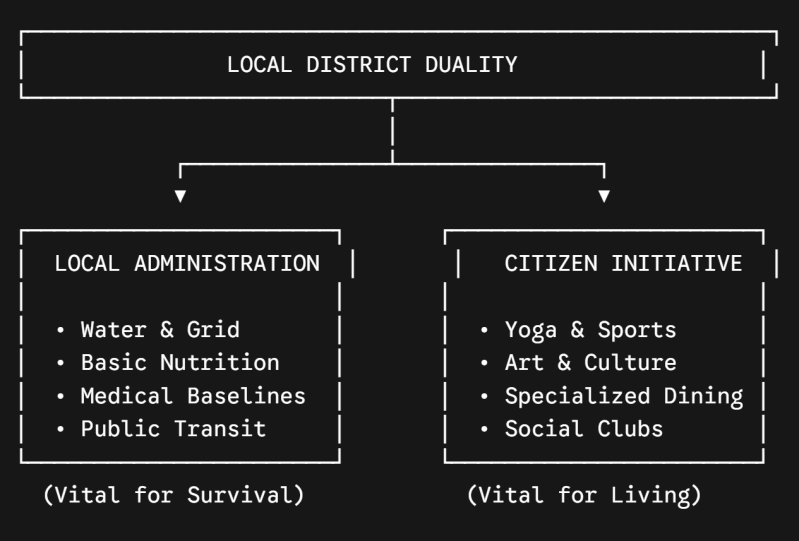
Under a human-centric technocracy, the local government (the administrative body of your district) does not run or manage everyday social life, hobbies, or cultural groups. It is deliberately designed to be as small and non-invasive as possible.
NOTE: Local government only sets up organisations that are vital for our survival.
The division of responsibility between the local administration and the citizens is clear:
1. The Local Administration: The Baseline Infrastructure Only
The local organization’s sole job is to manage the physical survival baseline (Stream A carbon allocations). They act like an automated utility company. They only set up and maintain what is absolutely vital to keep the physical machine of the district running safely:
-
Water filtration and automated sanitation systems.
-
The regional power grid and district heating/cooling.
-
The automated vertical farms and basic nutrition hubs.
-
The transit loops and medical diagnostic clinics.
If it does not directly impact the physical survival, public health, or basic safety of the population, the local administration does not touch it.
2. The Citizens: The Fabric of Culture and Play
Because the local administration only handles the bare essentials, everything else in society is set up, run, and shaped entirely by the citizens themselves.
Things like your yoga class, art studios, gaming leagues, theater groups, philosophy circles, and local specialized dining clubs are not created by a government decree.
3. The Administration's True Role: The Facilitator
Even though the local government doesn't start yoga classes, they are structurally mandated to facilitate it once you propose it.
They act as the bridge between your human imagination and the physical resources of the district. If you want to start something:
-
You provide the passion, the training, and the community.
-
They provide the empty room, the electricity, and the equipment (using the surplus physical capacity of the district).
This design ensures that "government" never becomes a massive, bloated bureaucracy trying to micro-manage human happiness. The machines and the technical administrators keep you alive, healthy, and warm—but you and your fellow citizens decide what makes that life actually worth living.