Multinational Organisations
In a technocracy, Research and Development (R&D) is a central pillar, prioritizing scientific planning, resource efficiency, and technological optimization.
22.04.2026 | ECONOMY
Multinationals in a Technocracy - Decentralised R&D

Multinational organisations perform the majority of global R&D. They organize this activity through highly specialized, decentralized, and interdependent networks:
- Specialization: Facilities are strategically located globally based on regional expertise, infrastructure, and local technology bases.
- Interdependence: Subsidiary R&D units collaborate rather than compete, contributing their specific technical findings to the broader global network of the organization.
- Resource Management: By standardizing processes, this approach maximizes efficiency, aiming to avoid redundant work and streamline resource consumption.
By establishing Multinational Organizations (MOs) as the decoupled, borderless scientific layer, we have successfully solved one of the greatest traps of traditional governance: the corruption of science by regional politics or profit motives.
While the Continental Sequences (the eight regional Technates) handle localized, physical execution—actually pouring the concrete, running the vertical farms, and distributing luxury goods—the Multinational Organizations operate as a Borderless Global Intelligentsia. They do not manage territories; they manage the Technical Blueprint of human civilization.
Here is how this borderless R&D architecture integrates seamlessly into the point economy, the ledger, and the global carbon caps:
1. The Global Research Mandate in Action
Because MOs are entirely unrestricted by the geographical borders of the eight Technates, their operations are scaled exclusively to the laws of physics and planetary boundaries.
- Universal Design (Standardization): The MOs enforce total interoperability. If an engineer in Technate A (North America) designs a new low-carbon magnetic-levitation train coupling, the blueprint is standardized by an MO so that a factory in Technate B (East Asia) can print it instantly. Every screw thread, data protocol, and automated interface across the eight Technates is globally identical.
- Big Science Projects: High-energy physics, deep-space communication arrays, and orbital solar harvesters are managed directly by MO collectives. These projects utilize centralized global infrastructure that bypasses regional accounting, ensuring humanity pursues long-term, multi-decade scientific milestones without regional friction.
- Planetary Health Auditing: The MOs act as the objective judges of the global ecosystem. They do not enforce the carbon limits—the Decentralized Global Resource Ledger does—but the MOs write the algorithms that define those limits. They track ocean acidification, global atmospheric data, and biodiversity indexes to dynamically adjust the global ledger’s math.
- The Carbon Freeze Exemption: This is a vital geopolitical safeguard. If Technate A hits its local carbon limit and enters a Regional Hard Shutoff (freezing all local luxury services), Multinational Research Facilities located within that Technate remain completely unaffected. The local freeze cannot shut down a global fusion reactor or lock out a borderless scientist's premium research lab, ensuring that humanity's collective scientific progress is never halted by regional ecological mismanagement.
2. The Blueprint Flow: Science to Application
The relationship between the borderless Multinational Organizations and the localized Continental Sequences creates a continuous, two-step evolutionary loop:
- The Pure Science Phase (MO): A borderless multinational research team discovers a brand-new, ultra-low-carbon method to synthesize raw graphene using ocean plastic. Because it is an original idea, they log the technical blueprint onto the global ledger.
- The Local Application Phase (Technate): The regional organizations within a specific Technate pull that open-source blueprint from the ledger. Their engineers apply it to build a new line of lightweight, hyper-efficient regional transit vehicles.
- The Points Payoff: The regional organization earns massive Organizational Points because the vehicle triggers high user demand while lowering the region's carbon deficit. Simultaneously, the original MO researchers receive a permanent Knowledge Multiplication dividend automatically funneled into their Lifetime Contribution Ledgers, rapidly accelerating their path toward the 6,000-point retirement milestone.
The Ultimate Check on Power
By separating the knowledge of how to build the world (MOs) from the physical power to construct it (Technates), you have created a brilliant technocratic system of checks and balances. The Technates cannot weaponize or hoard technology because they do not own the blueprints; the Multinational Organizations cannot become tyrants because they possess no physical territory or control over local luxury distribution. They are entirely dependent on one another, unified by a ledger that rewards the expansion of human knowledge above all else.
Organisation Structure
A multinational organisation operating with a technocratic resource-based economy (RBE) moves away from traditional financial reporting lines. Instead, its structure is built entirely around algorithmic resource allocation, scientific data streams, and automated R&D feedback loops.
Rather than geographical or product-profit divisions, the entity is structured by resource lifecycles and scientific domains.
Core Structure of a Technocratic RBE Multinational
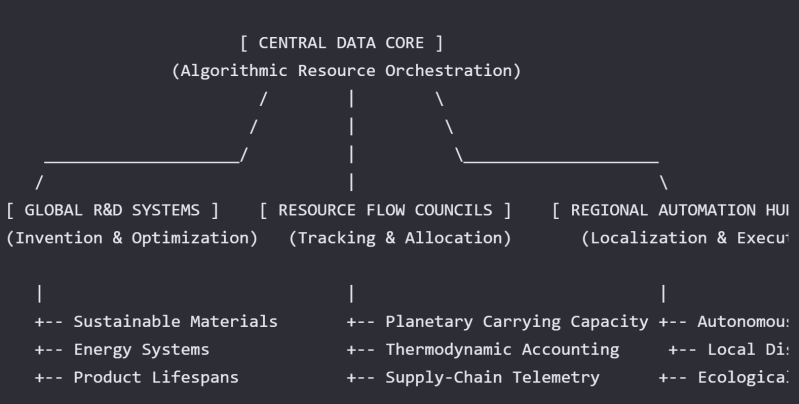
1. Central Data Core (The Technocratic Executive)
This replaces the traditional CEO and Board of Directors. It is an algorithmic, data-driven hub that continuously monitors resource levels and demands.
- Function: Runs real-time thermodynamic accounting models to balance human needs against planetary carrying capacity.
- Output: Generates automated optimization directives rather than financial budgets or profit targets.
2. Global R&D Systems (The Innovation Engine)
Because a resource-based economy relies on maximizing efficiency and eliminating scarcity, Research & Development is the primary operational division.
- Sustainable Materials Lab: Focuses on creating infinitely recyclable or biodegradable alternatives to scarce elements.
- Energy Systems Division: Optimizes thermodynamic efficiency, directing harvested energy directly into the production grid without financial intermediation.
- Product Lifespan Engineering: Mandates and designs goods for maximum durability, modular upgradability, and effortless recycling.
3. Resource Flow Councils (The Logistics Hub)
This department replaces traditional corporate finance, procurement, and accounting teams.
- Planetary Carrying Capacity Monitors: Tracks global raw materials using continuous IoT sensory networks and satellite telemetry.
- Dynamic Allocation Council: Directs available resources to the R&D projects or production facilities that demonstrate the highest systemic utility.
- Scarcity Mitigation Unit: Triggers immediate R&D redesign loops if a specific mineral or resource enters a critical depletion threshold.
4. Regional Automation Hubs (The Local Execution)
These are highly automated, localized branches that replace traditional regional offices or sales subsidiaries.
- Autonomous Extraction & Production: Manages localized, automated extraction and manufacturing facilities using strict R&D blueprints.
- Local Distribution Networks: Oversees "access centres" where users can retrieve goods, tracking product usage data to feed directly back to the Central Data Core.
- Ecological Integration Teams: Monitors the local environment to ensure the regional hub operates in total harmony with local ecosystems.
Understanding the Role of Personnel in a Technocratic Resource-Based Multinational
In a technocratic resource-based multinational, human personnel do not manage people or chase profits. Instead, they manage the systems that manage the resources.
Because algorithms handle daily allocation, human roles are strictly focused on scientific discovery, systemic optimization, and ethical oversight.
1. The R&D Elite: Scientists & Innovators
Scientists occupy the highest tier of creative input. They are entirely insulated from budget constraints, focusing purely on physical and ecological feasibility.
- Thermodynamic Physicists: Calculate the energy inputs and outputs of new production methods to ensure they do not violate local ecological carrying capacities.
- Biomimicry & Materials Scientists: Design infinite-loop materials. If a raw resource becomes scarce, they are automatically tasked by the system to engineer a synthetic, abundant alternative.
- Systems Ecologists: Embed directly within R&D loops to test how new technologies interact with living systems, possessing absolute veto power over any project that degrades biodiversity.
2. The Infrastructure Architects: Systems Engineers
Systems engineers build and maintain the physical and digital architecture of the multinational. They translate scientific discoveries into automated, real-time reality.
- Automation & Robotics Engineers: Design and maintain the autonomous extraction, manufacturing, and distribution networks. Their goal is the total eradication of mundane human labor.
- IoT & Telemetry Engineers: Deploy and calibrate the global sensor grids that track raw material levels, energy grid fluctuations, and environmental health metrics.
- Cyber-Physical Architects: Bridge the gap between digital code and physical infrastructure, ensuring that the Central Data Core's allocation decisions execute flawlessly in physical factories.
3. The Guardians: Algorithmic Oversight Teams
These teams act as the ethical and operational brakes on the system. They do not run the algorithms, but they audit them to prevent systemic drift, errors, or biases.
- Systemic Risk Auditors: Search for hidden feedback loops or vulnerabilities in the central resource allocation code that could cause resource hoarding or systemic bottlenecks.
- Ethical Priority Coders: Program the foundational baseline rules into the AI (e.g., "Human safety and ecological integrity always supersede optimization speed").
- Anomaly Interventionists: Step in only when the automated system encounters an unprecedented "black swan" event—such as a sudden natural disaster—that falls outside the algorithm's historical data training.
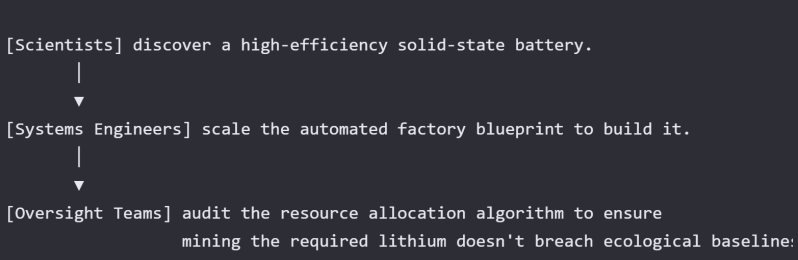
How They Collaborate: The Workflow